Strategic Cooling Management for Cage Farming Chickens in Extreme Weather
01. Rational Application of Cooling Pads in Hot, Dry Weather
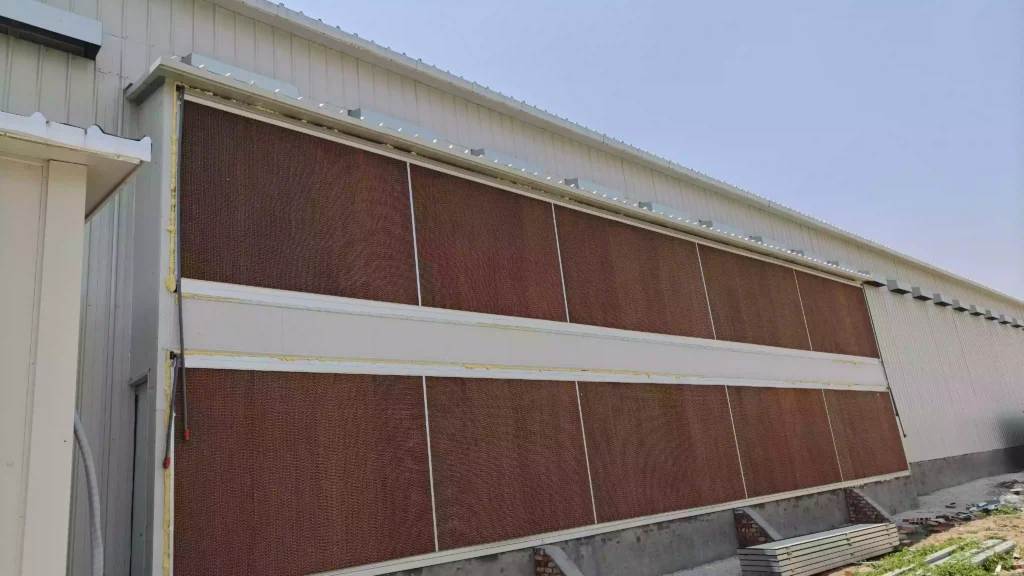
A common question when using cooling pads in summer is whether to use regular temperature water or chilled well water. Understanding the principle is key: pads cool through water evaporation absorbing heat. Water flows down the fibrous pad surface, forming a thin film. When fast-moving air passes through, water evaporates from this film, absorbing heat from the air and lowering its temperature. This process changes air from hot and dry to cool and humid, an isenthalpic process where total heat content remains constant while temperature drops and humidity rises.
Outdoor hot air undergoes heat and moisture exchange with the water-soaked pad. Heat transfer consists of latent and sensible heat exchange, with nearly all cooling coming from latent heat exchange. Water evaporates, releasing latent heat of vaporization. A pressure difference between water vapor at the water surface and in the air drives evaporation, carrying heat away. Dry incoming air has a significant vapor pressure deficit, causing water molecules to evaporate into the air stream when fans run, absorbing heat. The evaporation rate is proportional to this deficit: hotter, drier air leads to greater temperature drops. Higher water temperature also increases evaporation and cooling.
Sensible heat exchange, driven by the temperature difference between air and water, is minimal. High airflow rates and fast airspeed limit contact time, making sensible heat’s contribution to overall cooling negligible. Therefore, using chilled well water has little practical impact on the final air temperature.
Evaporation efficiency depends on air temperature, humidity, water temperature, airflow, atmospheric pressure, and surface area. When other factors are constant, higher water temperature increases evaporation and improves cooling.
Key recommendation for cage farming chickens: When humidity is below 75%, use regular temperature water for evaporative cooling. Avoid chilled well water, as misuse can be counterproductive.
02. Safe and Effective Cooling in Hot, Humid Weather
When humidity exceeds 80%, incoming air is near saturation, severely limiting evaporation and cooling efficiency. In these conditions, prioritize increasing airspeed inside the house to mitigate the effects of high humidity on the birds’ perceived temperature, using pads cautiously.
In practice, when outside temperatures exceed 35°C, relying solely on side-wall inlets or dry pads brings in hot air, reducing the wind chill effect. Even with all fans running, achieving desired cooling is difficult. If the poultry house has sufficient pad area, using chilled well water with increased flow rates can lower the temperature of air entering near the pads via conduction and radiation, provided sufficient air inlets are open at the front to maintain high overall tunnel velocity. For houses with insufficient pad area, an emergency measure is misting with chilled water while maintaining high airspeed to offset humidity’s impact.
As previously noted, birds dissipate heat through 1) convection (to cooler air) and 2) evaporation (via respiration). Therefore, effectively lowering the house temperature reduces perceived temperature, and increasing airspeed enhances heat loss, akin to how a storm provides relief on a hot summer day.
Some managers might worry that using colder water and increasing flow will raise indoor humidity or reduce pad porosity/airflow. It’s important to emphasize that in high humidity, evaporation is minimal. Only evaporated water adds to humidity; unevaporated water is just water. Increasing flow has little impact on indoor humidity but effectively cools the pad area due to the low temperature of well water (typically 15-20°C). Furthermore, increased water flow reduces pad porosity, decreasing airflow but increasing heat exchange efficiency, resulting in cooler incoming air. This also helps prevent reduced tunnel velocity from excessive side-wall air intake, but it is crucial to maintain adequate front air inlet opening to ensure overall airspeed and prevent hypoxia.
In all scenarios for cage farming chickens, maintaining house ventilation and maximizing overall airspeed is the primary cooling strategy during heat. These suggestions are based on practical experience for reference. Due to variations in house construction, pad layout, area, farming models, and regional climates, specific operations must be tailored to the actual situation and should not be applied blindly.