
Understanding and Applying Perceived Temperature in Environment Control Poultry Farm Management
01. What is Perceived Temperature?
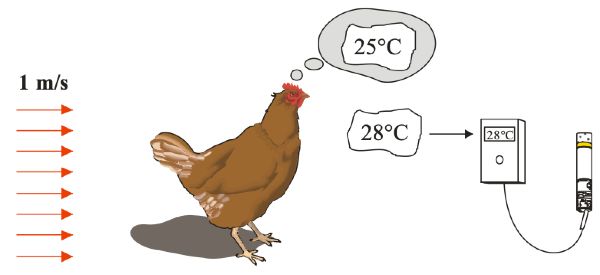
Perceived temperature is the degree to which birds feel hot or cold in their environment. Simply put, it is the temperature corresponding to the flock’s behavioral response to in Environment Control Poultry Farm changes compared to their behavior under ideal conditions, not the actual measured temperature value. In a dry winter, when the thermometer reads 28°C with no air movement, the birds feel 28°C. If a draft enters the house at 1 m/s, the actual temperature felt by the birds is not 28°C but 3-5°C lower (depending on external conditions). This difference between the felt temperature and the thermometer reading is the wind chill effect, and the temperature actually felt by the birds is the perceived temperature.
02. What Factors Influence Perceived Temperature?
Perceived temperature cannot be measured directly. It is influenced by ambient temperature, relative humidity, air velocity (wind speed), bird size, health status, and feather coverage. Besides these obvious factors, two critical but often overlooked elements are the temperature of the incoming air and flock density.
03. How to Apply These Factors to Solve Poultry Farming Challenges in an Environment Control Poultry Farm
1. Ambient Temperature
Experiments show that the higher the outside temperature, the smaller the wind chill effect. When the outside temperature exceeds 35°C, the wind chill effect felt by the birds is minimal. Conversely, lower outside temperatures result in a greater wind chill effect. Therefore, it is recommended not to use cooling pads when the outside temperature is below 28°C; use them when the wind chill effect is less significant.
2. Ambient Humidity
Higher humidity reduces the wind chill effect, raising the birds’ perceived temperature. This is similar to the mugginess felt in southern summers versus northern ones at the same temperature, or the discomfort before autumn rain versus a pleasant spring breeze. This principle aligns with the practice of avoiding cooling pads during or after rainy, humid weather.
3. In-House Air Velocity
Greater air velocity increases the wind chill effect, lowering the perceived temperature. Lower velocity reduces the effect, raising the perceived temperature. When cooling pads are ineffective in humid post-rain weather, closing them or running them intermittently while increasing air velocity can help.
4. Bird Age
Younger birds experience a greater wind chill effect; older birds experience less. This is related to feather coverage. Chicks should be protected from excessive wind chill, while older birds require stronger ventilation.
5. Flock Density
Higher density reduces the wind chill effect. Later in the cycle, flocks require greater ventilation, related to the rate of heat removal per unit time, which can be understood as needing higher air velocity.
04. Principles for Adjusting House Ventilation Using These Factors
Do not rely solely on thermometer readings—use them as a reference only. Do not trust others’ feelings of hot or cold. Trust what you see: the best indicators are flock comfort and the presence of huddling or panting. Calculating perceived temperature is a complex, multi-factor process requiring consideration of temperature, humidity, bird age, flock size, outside temperature, and ventilation rate. Mastering this is key to effective environment control poultry farm management.