
Ventilation in broiler housing systems: Strategies for Success
For broiler housing systems, the principle of ventilation is consistent: be meticulous and cautious in the early stages, and bold and proactive in the later stages.
1. Usage of Ventilation Pipes
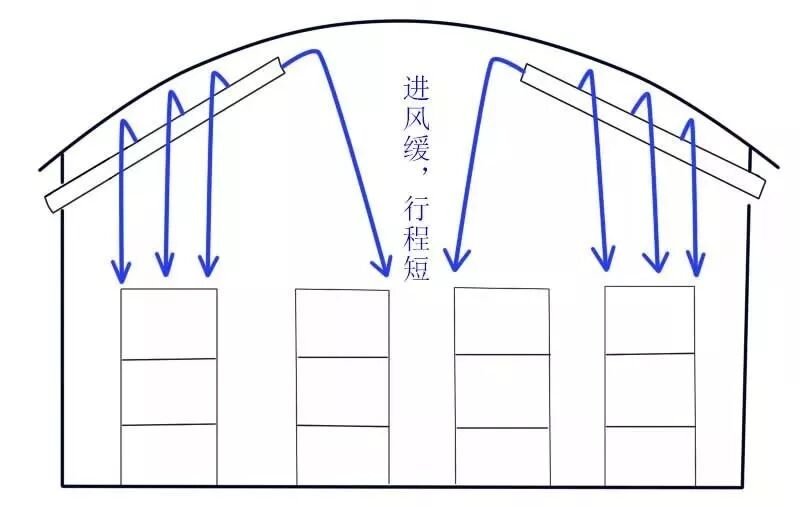
Ventilation in cage broiler systems does not differ fundamentally from other poultry rearing modes. However, since cage-reared chickens are farmed in a three-dimensional setup, the topmost layer of chickens is closer to the ceiling. Therefore, special attention must be paid to the descent of cold air, especially in houses using ventilation pipes. Given this situation, we can cover the top of the cages with plastic sheeting or plastic film to provide some protection. While this is not a fundamental solution, it can help prevent cold air from directly hitting the chickens. Thus, ventilation pipes should ideally be used during the early stages of rearing. When ventilation volume increases significantly, they should be combined with ventilation windows. The incoming air from the windows can also help agitate the air from the pipes, promoting better mixing.
2. Aligning Ventilation Windows with House Temperature
The opening of ventilation windows must be coordinated with both the ventilation rate and the localized temperature within the broiler housing systems. It is never as simple as opening all windows by the same amount. For example, during the mid-to-early stages of rearing, under standard negative pressure, the rear of the house often becomes cooler due to air leakage or faster incoming air near the exhaust fans. In such cases, we need to partially close the rear windows or open them intermittently to balance the temperature. Similarly, after the boiler is shut down in the later stages, the front of the house may become cooler due to the lack of a heat source, allowing us to reduce the opening of the front windows. In short, window adjustments are not one-size-fits-all; they require constant monitoring and adaptation.
Calculation Example:
Assumptions:
- Number of chickens: 25,000
- Average weight: 0.55 kg
- Minimum ventilation rate: 0.4 m³/kg/hour
- Exhaust fan capacity: 13,000 m³/hour
- Cycle time: 300 seconds
Formula:
On Time=300(25,000×0.55×0.4)/13,000×60≈127 seconds
Result:For this specific house setup, the ventilation cycle should be set to run for 127 seconds and then remain off for 173 seconds.
3. Minimum Ventilation and CO2 Targets
Minimum ventilation refers to the lowest volume of fresh air required per unit weight to meet the growth needs of the birds. Below this level, the air inside the broiler housing systems becomes polluted, hindering growth; above it, fuel is wasted. Using minimum ventilation during cold seasons ensures the birds’ basic needs are met while conserving energy and reducing the risk of respiratory issues caused by excessive ventilation.
CO2 Indicators:
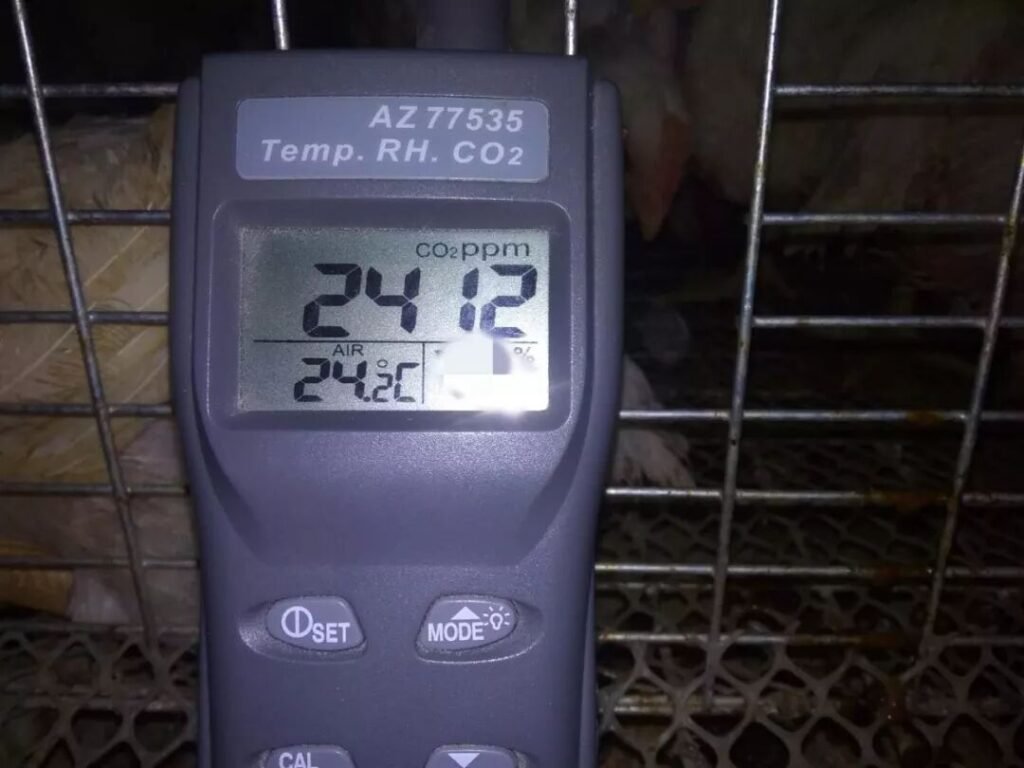
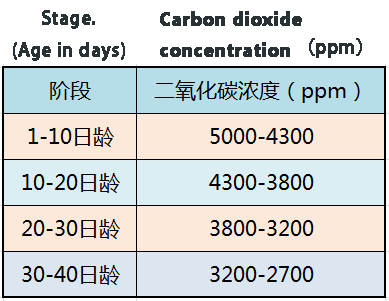
CO2 levels are primarily generated by the birds’ respiration. Under normal ventilation, CO2 concentration and oxygen levels have an inverse relationship, making CO2 measurement a vital indicator of air quality. During the current season, when outdoor temperatures typically range between -10°C and +5°C, the following CO2 standards can be applied:
(Note: These targets fluctuate throughout the day, with the lowest levels typically occurring at noon and the highest before dawn. A daily fluctuation of 15% is considered normal.)
Furthermore, the placement of the CO2 monitor is critical. It should be positioned where it is unaffected by the chickens’ direct respiration and kept in a static location.
4. Avoid Over-Ventilating Early, Don’t Be Too Conservative Late
I often say that colds are the biggest enemy in broiler rearing. Unreasonable ventilation—particularly excessive ventilation—is a major cause. Without advanced instruments to measure air quality parameters, we rely on our senses. In the first 25 days, our primary goal in the broiler housing systems is to ensure the flock’s health. As long as the air isn’t stuffy, a slight ammonia smell is acceptable.
However, the strategy changes in the later stages, especially after 30 days. My principle is: “Better to be a little cold than to suffocate the birds.” From day 30-35, it’s acceptable for the top layer of chickens to pant slightly from heat; after day 35, even the middle layers should not show signs of heat stress.