
Due to the rapid increase in energy/heating costs, the importance of providing an ideal environment for flocks is being overlooked. In most cases, the idea of trying to save costs by restricting energy use is misguided (Battery cage for chicken farm). While energy savings are feasible with more heat recovery devices available on the market (such as air energy systems), attempting to save equivalent energy without recovery devices adversely affects final performance and profits. Figure 1 shows what happens if ventilation is reduced during the first week. The flock may meet or even exceed the set targets. However, the damage caused by this substandard environment does not manifest until 21 days later, as reduced air quality impairs cardiovascular development. When early ventilation rates are prioritized, outcomes can be significantly different. This article outlines recommendations we believe are most beneficial for performance and ultimate cost.
Minimum Ventilation
This involves ensuring adequate oxygen supply while removing waste metabolites produced by bird growth and combustion processes from the environment, maintaining the minimum ventilation rate (air volume) required to achieve full genetic potential. The system should operate independently of any temperature control system and works best when managed by a combination of cycle timers and temperature-based controls. The timer cycle should be five minutes, with a minimum runtime of at least 20% of that cycle (e.g., one minute on, four minutes off for a five-minute cycle). Whenever air quality in Battery cage for chicken farm begins to deteriorate, runtime must be increased while reducing off-time to maintain the same total cycle length. If off-time is not reduced, even increasing runtime may not improve the percentage of operation, and air quality may still not improve. The minimum runtime should be about one minute, depending on the width of the house or the time required for air to move from the inlets to the ridge apex, where incoming air is heated, expands, and relative humidity decreases. This air must then descend to floor level, delivering oxygen to the birds and removing waste gases and moisture from flock metabolism and heating systems. The air needs to recirculate from the center of the house back to the sidewalls, ensuring proper ventilation at floor level, before returning to the top of the house and being exhausted by fans. The exhaust capacity of the minimum ventilation system fans should equal 12.5–20% of the house volume (achieving one air change every five to eight minutes) and operate on a timer. The system runs regardless of house temperature.
Air Inlets
Key points for air inlet management:
- All minimum ventilation inlets should direct air toward the apex of the house and close when fans are off.
- When negative pressure drops indoors, open ventilation inlets at the end can direct cold air to the floor, creating wind chill on birds and condensation on litter. The bottoms of all minimum ventilation inlets should be sealed airtight to prevent cold air from being directed toward the floor.
- All inlets should open from the top, not from the bottom, except when cooling.
- In open-truss structure houses, the angle of inlet openings must ensure air does not directly enter purlins and then be directed straight down to the floor.
- Inlets need sufficiently large openings to achieve the required static pressure and airflow. For sidewall inlets, an opening of at least 3 cm is required.
- Avoid obstacles (electrical conduits/concrete or wooden beams) as they disrupt airflow, forcing air toward the floor.
- Motorized inlets should be installed in the middle of the sidewall to reduce variations in inlet opening.
- In negative pressure ventilation systems, inlet placement, not fan location, determines uniformity of airflow distribution. For even air distribution, inlets should be evenly spaced throughout the house and opened to the same degree.
- Cable-operated inlets often stretch, causing uneven opening sizes for inlets connected to the same cable and poor airflow; aircraft cables stretch less than high-tension fence wires and are preferable. Solid 8mm rods stretch even less and are the best choice for long houses.
- A well-sealed house should achieve a negative pressure of at least 37.5 Pascals (Pa) with all inlets closed and one 1.2m fan running. If static pressure is below 25 Pa, the house is too leaky, and this must be addressed immediately.
- Inlets should be pressure-controlled to ensure constant inlet air velocity throughout the ventilation stage, independent of temperature control.
- All inlets must be externally windproofed.
- Inlets should be installed at least 60 cm from the front gable, provided airflow is not disrupted.
- Do not install heaters near inlets, as they cannot adequately heat cold air forced into the house at high velocity. Heaters should be placed where air velocity is below 1 m/s.
- Inlet airflow should always match the exhaust capacity of fans operating at actual working pressure.
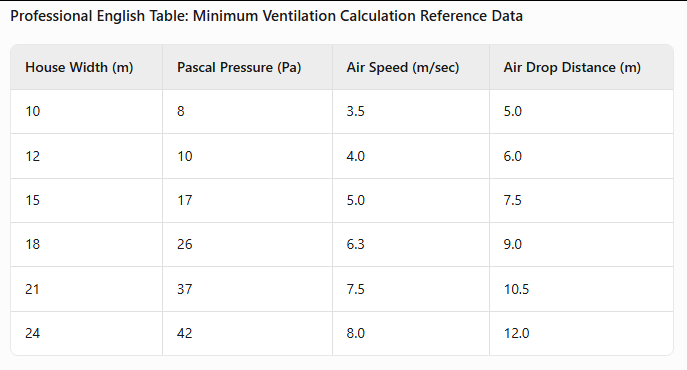
- Air enters the house by negative pressure and should reach halfway across the house before descending. This is a function of inlet area and fan exhaust capacity at actual working pressure. Total inlet area must be adjusted to provide the correct negative pressure based on house width. Table 1 provides recommended pressure guidelines for different house widths.
How to Calculate House Volume:
House volume = length × width × average height ((sidewall height + ridge height)/2)
Example: House width 23m, length 110m, sidewall height 1.5m, ridge height 4m
(1.5m + 4m)/2 = 2.75m
110m × 23m × 2.75m = 6,958 m³
How to Calculate Heater Capacity per m³:
We recommend a heater capacity of at least 0.05 kW/m³. Performance usually improves with increased heater capacity. New houses should have a heater capacity of 0.07 kW/m³. In countries with severe winters like Russia and Canada, this should be increased to 0.1 kW/m³.
Heater power per m³ = (number of heaters × heater output power (kW)) ÷ house volume (m³)
Example: 6 heaters × 80 kW each = 480 kW / 6,958 m³ = 0.069 kW/m³
How to Calculate Fan Exhaust Capacity per Minute:
Fan exhaust capacity per hour / 60 = exhaust capacity per minute
Example: 18,000 m³/h ÷ 60 = 300 m³/min
How Many Fans Are Needed for Minimum Ventilation:
House volume ÷ air exchange time ÷ fan exhaust capacity
Example: 6,958 m³ ÷ 8 min ÷ 300 m³/min = 2.9 fans, typically rounded up to 3 fans
How Many Inlets Are Needed for Minimum Ventilation:
We need to calculate the exhaust capacity of fans per second.
Number of minimum ventilation fans running × exhaust capacity per fan per hour / 3,600
Example: 3 fans × 18,000 m³/h ÷ 3,600 = 15 m³/s
Next, calculate the required air velocity through the inlets so that air reaches the ridge before descending. For a width of 23m, the required air velocity through the inlets is 8 m/s.
Fan exhaust capacity ÷ air velocity = inlet area required for minimum ventilation fan operation (m²)
Example: 15 m³/s ÷ 8 m/s = 1.875 m²
Summary:
- Heater power per m³ = 0.069 kW/m³
- Number of minimum ventilation fans = 3
- Inlet area required for minimum ventilation fans = 1.875 m²
All figures should be calculated based on actual house parameters, but the method remains consistent. These numbers are our field recommendations, based on unlocking genetic potential while balancing the costs of achieving high performance, high welfare, and optimal economic returns.
Ventilation data is always a topic of debate, with different experts offering varying answers. However, this point-by-point guide has been implemented worldwide with excellent results, including in battery cage for chicken systems where precise environmental control is critical for tiered housing configurations.